The Real Reason Your Shopify Store Has Traffic But No Conversions
The Real Reason Your Shopify Store Has Traffic But No Conversions
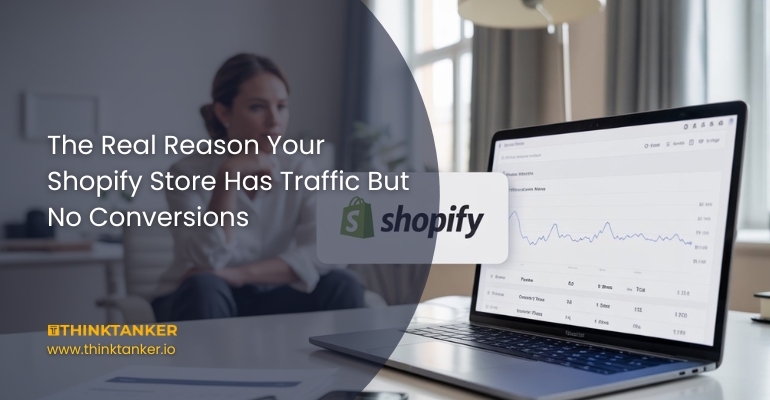
If your Shopify store is attracting visitors but failing to convert them into customers, this usually points to a deeper execution problem rather than a marketing issue. We see this situation often when reviewing live Shopify stores for businesses already investing in ads, SEO, or influencer traffic.
The store looks active. Sessions are coming in consistently. Yet orders don’t match the effort.
At this stage, many businesses assume they need more traffic. In reality, traffic without conversions usually means the store is not doing its job properly. This is where the difference between a DIY setup and an experienced shopify development company becomes obvious.
Traffic shows interest, conversions show trust
Traffic only tells you that people are curious. Conversions happen when visitors feel confident enough to take action. Most Shopify stores that don’t convert fail to bridge this gap.
A store can look visually clean and still struggle to sell. Design alone does not guide decisions. Structure, flow, performance, and clarity matter far more once real users start interacting with the site.
For growing businesses, this distinction is critical.
Why most Shopify stores struggle to convert
After working with multiple Shopify businesses across different industries, certain patterns repeat themselves. These problems are rarely obvious at first glance, but they directly impact buying behavior.
1. Visitors feel unsure, not convinced
Many stores assume that showing products is enough. In practice, visitors need direction. They need to understand what to look at, what to compare, and what to do next.
When navigation is built for aesthetics rather than intent, users browse without committing. On mobile, this problem becomes even more noticeable. Buttons exist, but they don’t communicate urgency or clarity. As a result, visitors leave without making a decision.
This is usually a structural issue, not a content one.
2. Performance problems hide behind “acceptable” speed
A Shopify store can feel fast while still underperforming where it matters most. Product interactions, cart actions, and checkout steps are often slower than they should be.
These delays usually come from heavy themes, unnecessary scripts, and too many apps working in the background. Each small delay adds friction, and friction quietly kills conversions.
Fixing this properly requires more than installing another plugin. It requires a technical review as part of a professional shopify website development service, where performance is treated as a conversion factor, not just a speed metric.
3. Ready-made themes stop supporting growth
Themes are designed for general use. They work well when a business is just starting out. As soon as the store grows, limitations start to show.
Businesses need flexibility. They need custom product flows, landing pages built around campaigns, and layouts aligned with how customers actually buy. Themes rarely support this without heavy workarounds.
When stores keep stacking apps to compensate, performance drops and maintenance becomes harder. This is usually the point where custom Shopify development becomes a necessity rather than a choice.
4. Checkout is where trust quietly breaks
A large percentage of conversion loss happens at checkout. This is often due to small but critical details.
Unclear shipping information, inconsistent messaging, missing reassurance, or a confusing payment experience can make users hesitate at the last moment. These issues don’t always show up in analytics, but they show up in abandoned carts.
Checkout optimization is not about cosmetic changes. It’s about understanding buyer hesitation and removing it through thoughtful execution.
Why quick fixes rarely solve the problem
When conversions drop, most businesses try to fix things fast. They add apps, change freelancers, or attempt to hire Shopify developers for isolated tasks.
The problem is that conversion issues are rarely isolated. They span user experience, performance, structure, and business logic. Fixing one part without addressing the rest often creates new problems elsewhere.
This is why many growing brands eventually move away from patchwork fixes and toward structured Shopify development services.
How experienced Shopify development companies approach conversion issues
A professional shopify development company doesn’t start with assumptions. It starts with analysis.
The focus is on understanding how users move through the store, where hesitation occurs, and why intent fails to convert. Design, performance, and functionality are aligned with business goals rather than trends.
This approach is fundamentally different from task-based development. It treats the store as a revenue system, not just a website.
What actually improves conversions in real Shopify projects
In real-world projects, conversion improvement usually comes from multiple small but meaningful changes working together.
Clearer product journeys help users understand what matters. Simplified navigation reduces cognitive load. Faster interactions remove friction at key moments. Custom sections built around intent perform better than generic layouts.
When performance and user experience are handled together, conversion gains are consistent and measurable. This is why businesses investing in professional Shopify development services see better long-term results than those relying on quick fixes.
When hiring a developer is not enough
There is a clear difference between getting development work done and fixing a real conversion problem.
Individual developers are useful for specific tasks, and many businesses initially decide to hire shopify developers to address immediate technical needs. However, conversion issues usually go beyond code alone.
Improving conversions requires coordination between design, development, performance, and a clear understanding of how customers behave and make decisions.
That’s why, in many cases, companies realize they don’t just need code execution; they need direction, accountability, and a structured approach to solving the problem.
The real takeaway
If your Shopify store has traffic but no conversions, the issue is rarely marketing. Its execution.
More ads, more plugins, or more traffic won’t fix a store that isn’t built to convert.
Growth at this stage comes from refining structure, improving performance, and aligning the store with how customers actually make decisions.
That’s where an experienced shopify development company adds real value, by turning existing traffic into consistent revenue instead of chasing more visitors.
Frequently Asked Questions (FAQs)
Why does my Shopify store get traffic but still fail to convert?
In most cases, the issue is not traffic quality but store execution. Problems like unclear user flow, slow performance, theme limitations, and checkout friction prevent visitors from taking action. These are structural issues that require deeper optimization rather than more marketing.
Can conversion issues be fixed without rebuilding a Shopify store?
Some conversion problems can be improved through optimization, but many stores hit limitations due to how they were originally built. When performance, UX, and flexibility are restricted by themes or heavy app usage, working with a Shopify development company often becomes the more effective long-term solution.
Is hiring individual Shopify developers enough to improve conversions?
Individual developers can help with specific tasks, but conversion problems usually involve multiple areas working together. When design, performance, and business logic are not aligned, isolated fixes rarely deliver consistent results. This is why many businesses move beyond single hires and look for a more structured approach.
How do Shopify development services improve conversion rates?
Professional Shopify development services focus on removing friction across the entire buying journey. This includes improving store structure, optimizing performance, customizing user flows, and refining checkout experiences so visitors feel confident completing a purchase.
When should a business consider working with a Shopify development company?
If your store already has traffic but struggles with sales, frequent app dependencies, performance issues, or scaling limitations, it is usually the right time to involve a Shopify development company. At this stage, improving execution often delivers better ROI than increasing traffic alone.

Related Posts