Can ERPNext Handle Your Business? What to Know Before You Decide
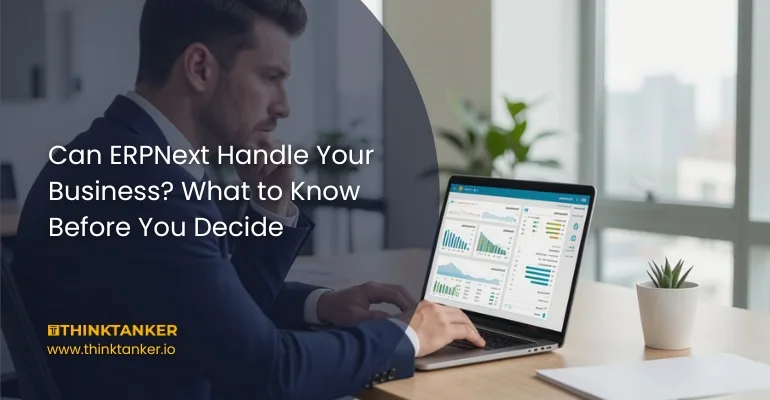
Can ERPNext Handle Your Business? What Nobody Tells You Before You Decide
Choosing the right system to manage your business is not just a technical decision. It directly impacts how your operations run, how your teams collaborate, and how efficiently you scale.
Many businesses today consider ERPNext because it is flexible, open source, and capable of handling multiple business functions in one place.
But the real question is not what ERPNext can do.
The real question is whether ERPNext can actually handle your specific business operations in a practical, scalable way.
Before making a decision, it is important to understand both the strengths and the realities that are often not discussed openly.
Can ERPNext Really Handle Your Business Operations
ERPNext is designed as an all in one business management system. It brings together multiple functions such as sales, inventory, accounting, HR, and purchasing into a single platform.
For many growing businesses, this eliminates the need to manage separate tools for each function. Data flows across departments without manual duplication, and reporting becomes more consistent.
From a capability standpoint, ERPNext can handle a wide range of operations. It supports inventory tracking, invoicing, financial accounting, order management, and even manufacturing workflows.
However, capability alone is not enough. The real difference comes from how well the system is implemented and aligned with your business processes.
Where ERPNext Works Well for Businesses
ERPNext works particularly well for businesses that are looking to move away from manual processes and disconnected systems.
For small and medium businesses, it provides a structured way to manage operations without investing in expensive enterprise software.
Manufacturing businesses can use ERPNext to manage production planning, track raw materials, and monitor finished goods. Trading businesses benefit from centralized inventory and order management.
Service based companies can manage projects, billing, and team activities within the same system.
It is also a strong fit for businesses that are growing and need better visibility into operations across multiple departments or locations.
When implemented correctly, ERPNext helps businesses create a single source of truth for their data.
Where Businesses Face Challenges with ERPNext
This is the part that most businesses discover only after they start using the system.
ERPNext is powerful, but it is not plug and play for every business. Many organizations face challenges during setup and initial usage.
One common issue is that standard workflows may not fully match real business processes. This creates friction, especially when teams are used to existing methods of working.
Another challenge is data migration. Moving data from spreadsheets or legacy systems into ERPNext requires planning and accuracy.
Some businesses also underestimate the learning curve. Teams need training to use the system effectively, and without proper guidance, adoption becomes slow.
These challenges do not mean ERPNext is not suitable. They highlight the importance of proper planning and implementation.
Do You Need Customization or Is Standard ERPNext Enough
A common question businesses ask is whether the standard version of ERPNext is enough.
For some businesses, the standard setup works well, especially if their processes are simple and aligned with common industry practices.
However, many businesses require customization. This may include custom workflows, approval systems, reports, or integrations with other tools.
Customization allows ERPNext to reflect how your business actually operates instead of forcing your team to adjust to the system.
At the same time, customization needs to be done carefully to ensure long term stability and scalability.
What Nobody Tells You About ERPNext Implementation
The biggest difference between success and failure with ERPNext is not the software itself. It is the implementation approach.
ERPNext implementation is not just about installing the system. It involves understanding your business processes, mapping workflows, configuring modules, and training your team.
Many businesses struggle because they rush this process or treat it as a simple setup task.
Implementation also takes time. Depending on the complexity of your operations, it can take weeks or even months to fully deploy and stabilize the system.
Another important factor is decision making. Businesses need clarity on how they want their processes to work before configuring the system.
Without this clarity, even a powerful system like ERPNext can feel difficult to manage.
How ThinkTanker Helps Businesses Implement ERPNext Successfully
At ThinkTanker, ERPNext is not approached as just a software solution. It is treated as a business transformation tool.
The focus is on understanding real business workflows and aligning ERPNext with those workflows from the beginning.
This includes structured implementation planning, process mapping, and careful configuration of modules.
Customization is handled in a way that supports long term growth while maintaining system stability.
Integration with existing tools and data migration are managed with attention to accuracy and continuity.
Most importantly, businesses are supported throughout the process so that their teams can confidently use the system in day to day operations.
This approach helps organizations move from confusion and complexity to clarity and control.
Ready to Find Out If ERPNext Is Right for Your Business
If you are considering ERPNext or struggling with your current systems, the right guidance can make a significant difference.
Understanding whether ERPNext fits your business requires more than feature comparison. It requires a clear view of your processes, challenges, and goals.
Schedule an ERPNext consultation with ThinkTanker to evaluate how ERPNext can be implemented effectively for your business operations.
Frequently Asked Questions (FAQs)
Can ERPNext handle small business operations effectively?
Yes, ERPNext is well suited for small businesses, especially those looking to manage multiple functions such as inventory, accounting, and sales within a single system.
Is ERPNext worth it for growing businesses?
ERPNext can be highly valuable for growing businesses that need better control over operations and data. Its flexibility allows it to scale as the business expands.
Can ERPNext handle accounting and GST compliance?
Yes, ERPNext includes accounting features and supports GST compliance, making it suitable for businesses operating in India.
Do I need a developer to run ERPNext?
Basic usage does not always require a developer, but implementation, customization, and advanced configurations often benefit from expert support.
How long does it take to implement ERPNext?
The timeline depends on the complexity of the business. Simple setups may take a few weeks, while more complex implementations can take longer.

Related Posts